

Nissan diagnostic trouble codes are structured according to OBD-II standards, but there are several important Nissan-specific details that technicians need to understand when working with a scan tool. The first character of the code identifies the system: P stands for Powertrain, C for Chassis, B for Body, and U for Network/CAN communication. The second character “0” means a generic SAE code that can be recognized by any scan tool, while “1” indicates a manufacturer-specific code. A large portion of Nissan-specific faults are located in the P1xxx group, and these are exactly the codes that low-cost universal ELM327 adapters often fail to display or decode correctly.
Nissan uses a wide range of proprietary systems, each with its own fault codes: CVTC — Continuously Variable Timing Control; VVEL — Variable Valve Event and Lift, used on VQ37VHR engines; MPI/DIG-T — port and direct injection systems; and Jatco CVT — Nissan’s continuously variable transmission used on most modern Nissan models. Correct diagnostics of these systems requires an up-to-date professional database.
Common Nissan Trouble Codes: Reference Table
The table below summarizes the most common trouble codes found on Nissan vehicles, based on real diagnostic cases for Nissan Murano and other popular models in the MotorData database. The table covers engine management, sensors, control systems and data bus faults. When reading parameters with a Nissan scan tool, abbreviated names are often used. In this table, those scan-tool abbreviations are shown in the Short Name column and are especially useful for diagnostics.
| Code | Short Name | Description | Typical Models |
|---|---|---|---|
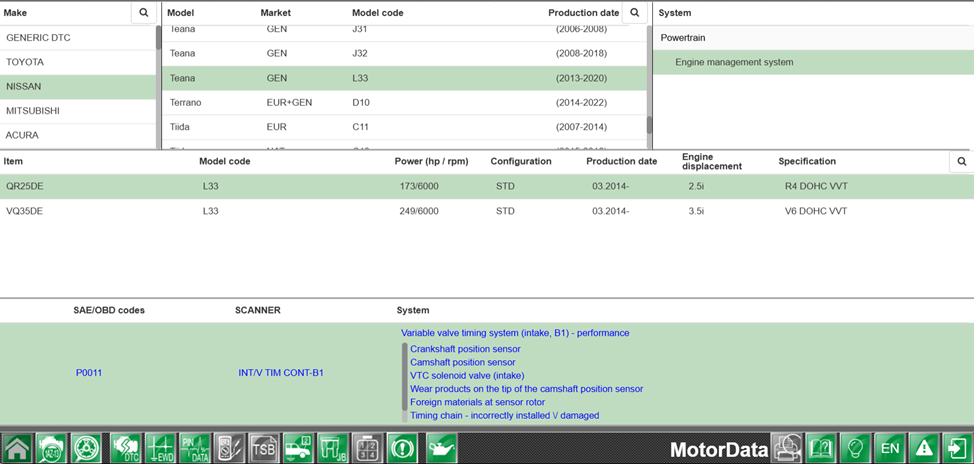
| P0011 | INT/V TIM CONT-B1 | Variable valve timing control system, intake, Bank 1 — performance fault | Murano, X-Trail T32, Teana L33, Qashqai J11 |
| P0014 | EXH/V TIM CONT-B1 | Variable valve timing control system, exhaust, Bank 1 — performance fault | Murano, X-Trail T32, Teana L33 |
| P0031 | A/F SEN1 HTR (B1) | Air/fuel ratio sensor, B1S1, heater control circuit low | Murano Z50/Z51, Teana, Pathfinder |
| P0032 | A/F SEN1 HTR (B1) | Air/fuel ratio sensor, B1S1, heater control circuit high | Murano Z50/Z51, Teana, Pathfinder |
| P0037 | HO2S2 HTR (B1) | Heated oxygen sensor, B1S2, heater control circuit low | Murano, X-Trail, Qashqai |
| P0038 | HO2S2 HTR (B1) | Heated oxygen sensor, B1S2, heater control circuit high | Murano, X-Trail, Qashqai |
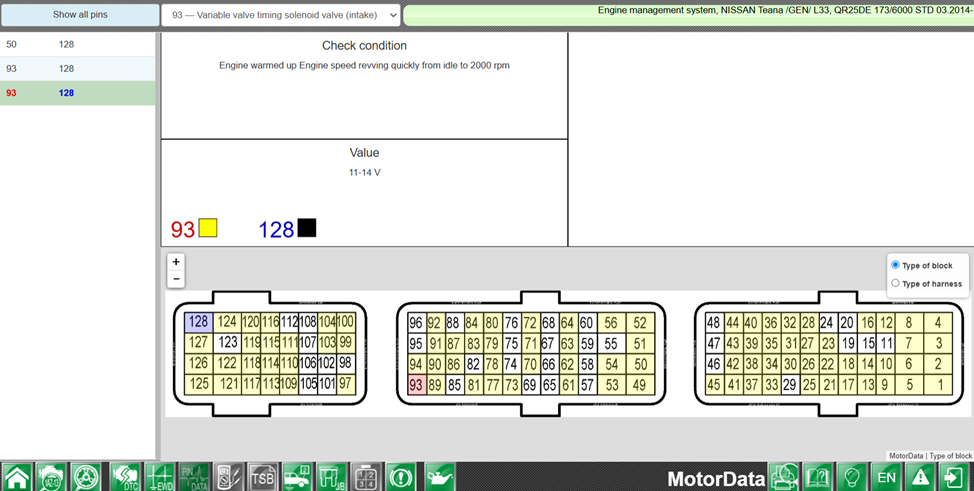
| P0075 | INT/V TIM V/CIR-B1 | Intake valve timing control solenoid valve, Bank 1 — circuit fault | Murano, Teana J32/L33, Pathfinder R51 |
| P0078 | EX V/T ACT/CIRC-B1 | Exhaust valve timing control solenoid valve — circuit fault | Murano, Teana, X-Trail T32 |
| P0087 | LOW FUEL PRES | Fuel rail/system pressure too low | Murano DIG, Juke 1.6T, Qashqai J11 |
| P0088 | HIGH FUEL PRES | Fuel pressure too high | Murano DIG, Juke 1.6T |
| P0101 | MAF SEN/CIRCUIT-B1 | Mass air flow sensor — range/performance fault | Murano, X-Trail, Qashqai, Teana |
| P0102 | MAF SEN/CIRCUIT | Mass air flow sensor circuit low input | Almera Classic, Tiida, Note, Primera |
| P0103 | MAF SEN/CIRCUIT | Mass air flow sensor circuit high input | Almera Classic, Tiida, Note |
| P0117 | ECT SEN/CIRCUIT | Engine coolant temperature sensor circuit low input | Murano, Teana, X-Trail, Pathfinder |
| P0118 | ECT SEN/CIRCUIT | Engine coolant temperature sensor circuit high input | Murano, Teana, X-Trail |
| P0122 | TP SEN 2/CIRC | Throttle position sensor 2 circuit low input | Murano Z51, Teana L33, X-Trail T32 |
| P0123 | TP SEN 2/CIRC | Throttle position sensor 2 circuit high input | Murano Z51, Teana L33 |
| P0130 | A/F SENSOR1 (B1) | Air/fuel ratio sensor, B1S1 — circuit fault | Murano, Teana, Pathfinder, Maxima |
| P0131 | A/F SENSOR1 (B1) | Air/fuel ratio sensor, B1S1 — circuit low input | Murano Z50/Z51, Teana J31/J32 |
| P0132 | A/F SENSOR1 (B1) | Air/fuel ratio sensor, B1S1 — circuit high input | Murano Z50/Z51, Teana J31/J32 |
| P0133 | A/F SENSOR1 (B1) | Air/fuel ratio sensor, B1S1 — slow response | Murano, Teana, Pathfinder |
| P0137 | HO2S2 (B1) | Heated oxygen sensor, B1S2 — circuit low input | Murano, X-Trail, Qashqai, Teana |
| P0138 | HO2S2 (B1) | Heated oxygen sensor, B1S2 — circuit high input | Murano, X-Trail, Teana |
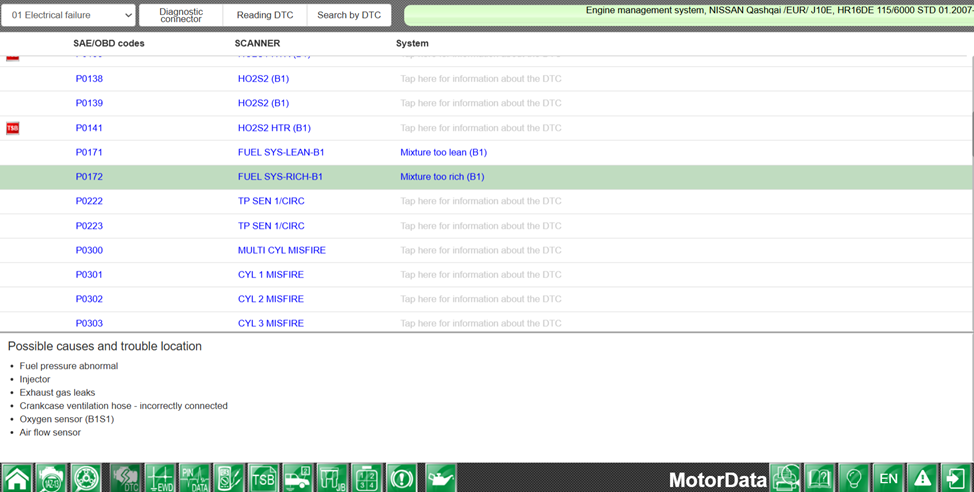
| P0171 | FUEL SYS-LEAN-B1 | System too lean, Bank 1 | Murano Z50/Z51, X-Trail T30/T31, Qashqai J10, Teana |
| P0172 | FUEL SYS-RICH-B1 | System too rich, Bank 1 | Murano, X-Trail, Teana, Juke |
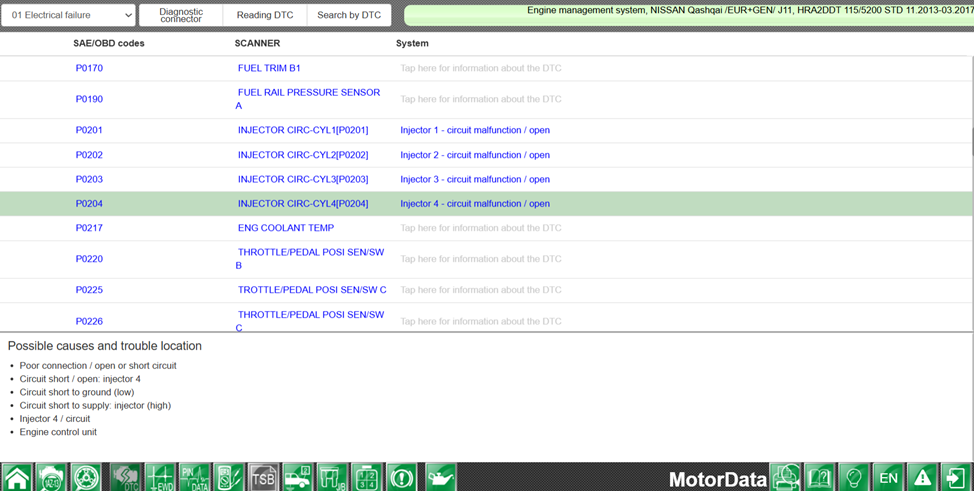
| P0201 | INJECTOR CIRC-CYL1 | Cylinder 1 injector circuit fault/open circuit | All Nissan models with MPI/DIG |
| P0202 | INJECTOR CIRC-CYL2 | Cylinder 2 injector circuit fault/open circuit | All Nissan models with MPI/DIG |
| P0203 | INJECTOR CIRC-CYL3 | Cylinder 3 injector circuit fault/open circuit | All Nissan models with MPI/DIG |
| P0204 | INJECTOR CIRC-CYL4 | Cylinder 4 injector circuit fault/open circuit | All Nissan models with MPI/DIG |
| P0222 | TP SEN 1/CIRC | Throttle position sensor 1 circuit low input | Murano, Teana, X-Trail, Qashqai |
| P0223 | TP SEN 1/CIRC | Throttle position sensor 1 circuit high input | Murano, Teana, X-Trail |
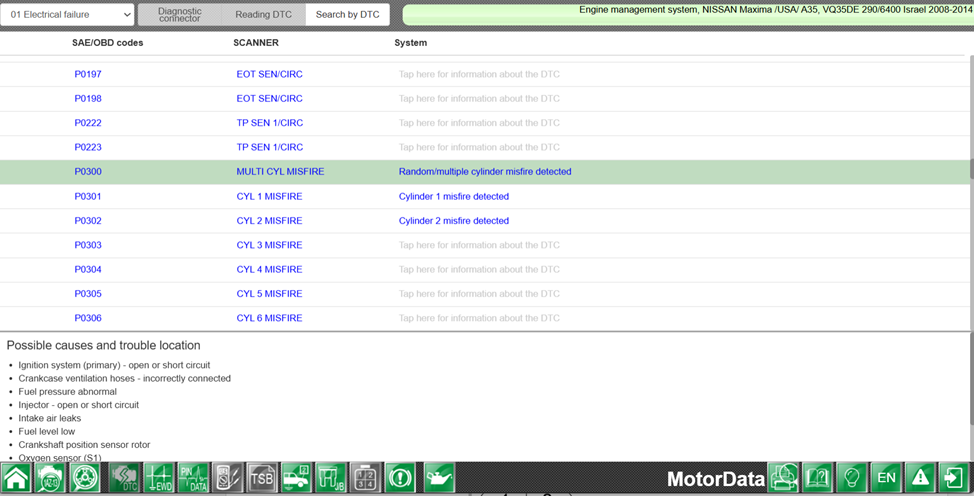
| P0300 | MULTI CYL MISFIRE | Random/multiple cylinder misfire detected | All Nissan models |
| P0301 | CYL 1 MISFIRE | Cylinder 1 misfire detected | All Nissan models |
| P0302 | CYL 2 MISFIRE | Cylinder 2 misfire detected | All Nissan models |
| P0303 | CYL 3 MISFIRE | Cylinder 3 misfire detected | All Nissan models |
| P0304 | CYL 4 MISFIRE | Cylinder 4 misfire detected | All Nissan models |
| P0325 | KNOCK SEN/CIRC-B1 | Knock sensor, Bank 1 — circuit fault | Murano VQ35, Teana, X-Trail QR25 |
| P0328 | KNOCK SEN/CIRC-B1 | Knock sensor, Bank 1 — circuit high input | Murano VQ35, Teana, X-Trail |
| P0335 | CKP SEN/CIRCUIT | Crankshaft position sensor circuit fault | X-Trail T30, Almera Classic, Primera P11/P12 |
| P0340 | CMP SEN/CIRC-B1 | Camshaft position sensor, intake, Bank 1 — circuit fault | X-Trail T30/T31, Presage, Almera |
| P0420 | TW CATALYST SYS-B1 | Three-way catalyst system efficiency below threshold, Bank 1 | Murano, Teana, X-Trail, Qashqai, Juke |
| P0444 | PURG VOLUME CONT/V | EVAP purge volume control solenoid valve — open circuit | Murano, Teana, X-Trail, Qashqai |
| P0445 | PURG VOLUME CONT/V | EVAP purge volume control solenoid valve — short circuit | Murano, Teana, X-Trail |
| P0455 | EVAP LEAK (LARGE) | EVAP system large leak detected | All Nissan models from 1996 onward |
| P0500 | VEHICLE SPEED SEN | Vehicle speed sensor fault | Murano, X-Trail, Qashqai, Teana |
| P0507 | IAC SYS HIGH RPM | Idle air control system — idle speed higher than expected | Murano Z50/Z51, Teana J31/J32 |
| P0520 | EOP SENSOR/SWITCH | Engine oil pressure sensor/switch circuit fault | Murano, Pathfinder, X-Trail |
| P0524 | ENGINE OIL PRESSURE | Engine oil pressure too low | Murano, Teana, Pathfinder, Navara |
| P0603 | ECM BACK UP/CIRCUIT | Engine control module backup power supply circuit | Murano, Teana, X-Trail, Qashqai |
| P0604 | ECM RAM ERROR | Engine control module RAM error | Murano, X-Trail, Qashqai |
| P0605 | ECM ROM/CIRCUIT | Engine control module internal fault / ROM error | Murano, Teana, X-Trail |
| P0606 | CONTROL MODULE | Powertrain control module processor fault | Murano Z50, X-Trail T31, Qashqai J10 |
| P0643 | SENSOR POWER/CIRC | Sensor power supply circuit — short circuit | Murano, Teana, X-Trail T32 |
| P1217 | ENG OVER TEMP | Engine overtemperature | Murano, Teana, Pathfinder, Navara |
| P1273 | A/F LEAN SHIFT B1 | Air/fuel ratio sensor, B1S1 — lean shift monitoring | Murano Z50/Z51, Teana J31/J32, Pathfinder R51 |
| P1283 | A/F LEAN SHIFT B2 | Air/fuel ratio sensor, B2S1 — lean shift monitoring | Murano Z50/Z51, Teana J31/J32 |
| P1148 | CLOSED LOOP B1 | Closed-loop fuel control function fault, Bank 1 | Murano, Teana, Pathfinder with VQ35DE |
| P1168 | CLOSED LOOP B2 | Closed-loop fuel control function fault, Bank 2 | Murano Z50/Z51, Teana J31/J32 |
| P2100 | ETC MOT PWR | Throttle control motor relay power supply circuit open | Murano Z51, Teana L33, X-Trail T32 |
| P2101 | ETC FNCTN/CIRC | Electric throttle control actuator — range/performance fault | Murano Z51, Teana L33, X-Trail T32 |
| P2135 | TP SENSOR CORR | Throttle position sensor correlation/range-performance fault | Murano, Teana, X-Trail, Qashqai |
| U0101 | LOST COMM (TCM) | Lost communication with transmission control module, TCM | Murano, Teana, Pathfinder with AT/CVT |
| U1000 | CAN COMM CIRCUIT | CAN communication circuit fault | All Nissan models with CAN bus |
| U1001 | CAN COMM CIRCUIT | CAN communication circuit fault, additional code | All Nissan models with CAN bus |
Nissan Engine Trouble Codes: Detailed Diagnostic Review Using MotorData Automotive Wiring
P0101 — Mass Air Flow Sensor Range/Performance
The mass air flow sensor is the ECU’s “eyes” in the intake tract. Code P0101 means the MAF readings do not match the expected values under the current engine operating conditions. This code is found on many vehicles, including Nissan Almera Classic with the GA16DE engine, Tiida and Note with HR16DE, and Micra K12.
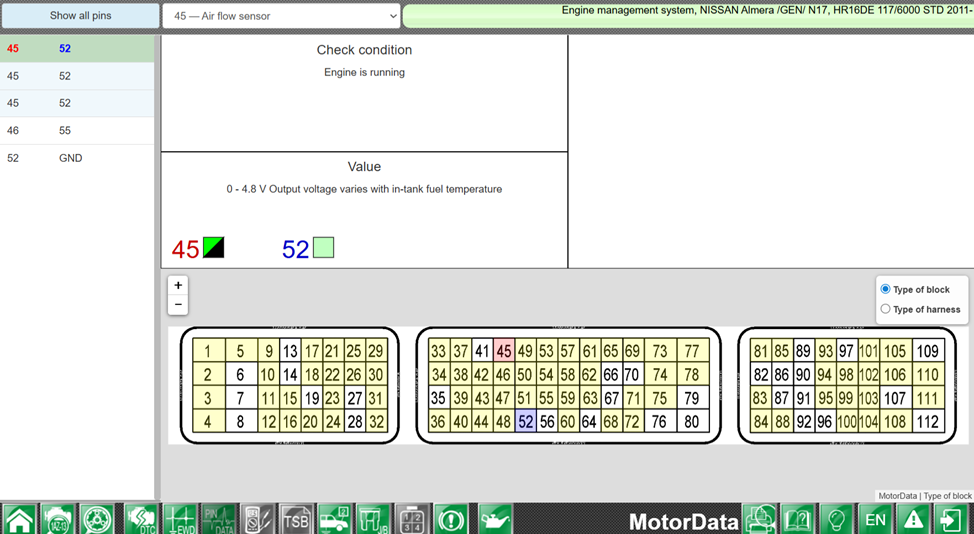
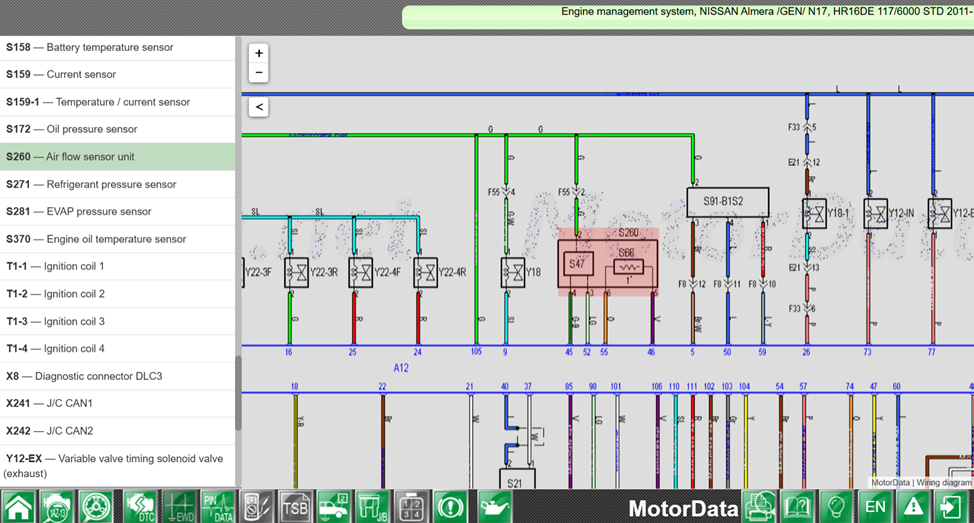
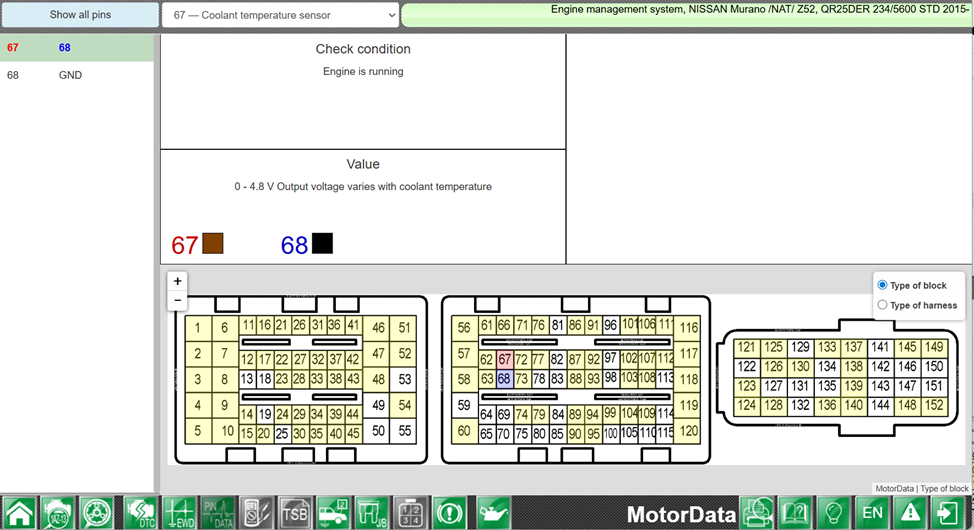
Contamination of the MAF sensing element is the main cause on vehicles with more than 80,000–100,000 km. Cleaning the sensor with a dedicated MAF cleaner often clears the fault without replacing the sensor, but only if the sensing element has no mechanical damage. Codes P0102, low input, and P0103, high input, belong to the same group and point to an electrical fault in the MAF circuit. The PinData section shows the connection points and test conditions.
P0117 / P0118 — Engine Coolant Temperature (ECT) Sensor, Circuit Low / High
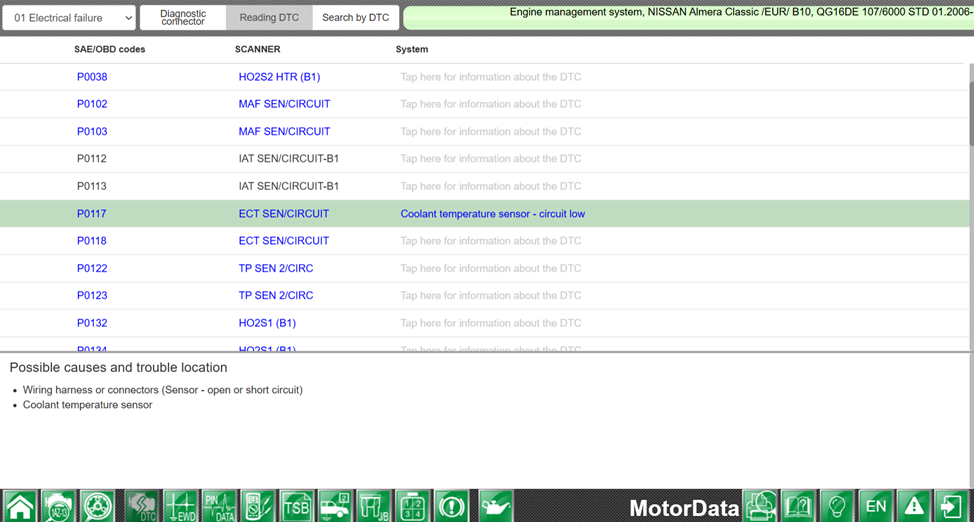
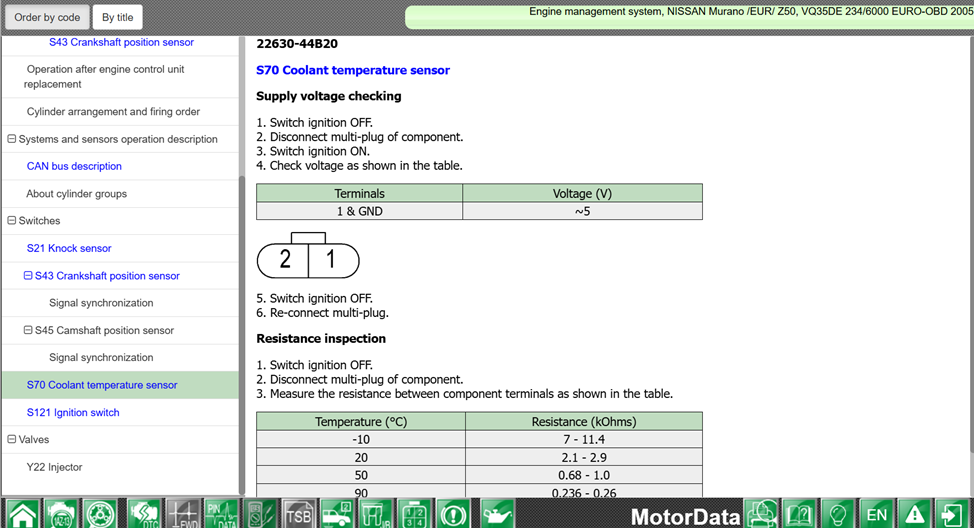
These codes indicate a problem with the ECT sensor — one of the key inputs used for fuel mixture control, ignition timing and cooling fan operation. On Nissan models from the late 1990s and early 2000s, the ECT sensor often fails after 100,000–150,000 km.
Typical external symptoms include an excessively rich mixture and increased fuel consumption when the engine is already warm because the ECU “thinks” the engine is still cold. Another possible symptom is incorrect operation of the cooling fan system.
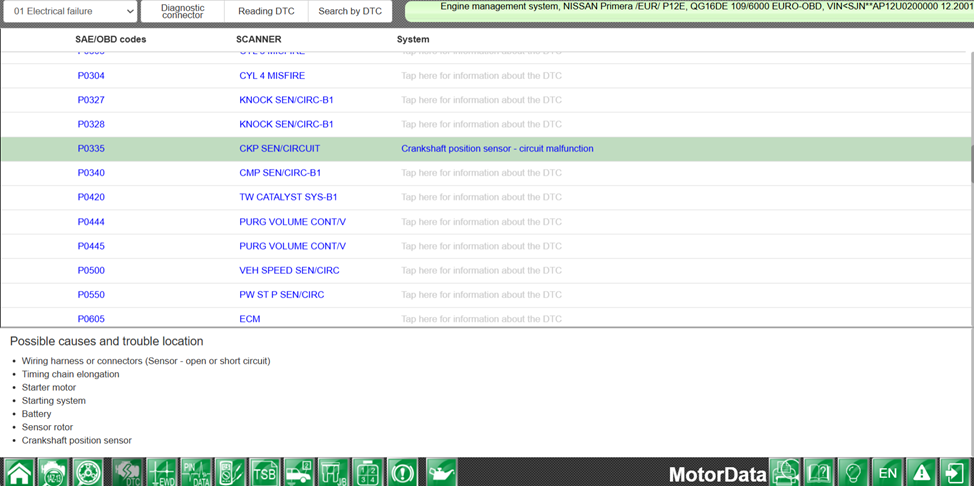
P0335 — Crankshaft Position Sensor Circuit Fault
The CKP sensor is critical: without its signal, the engine will not start at all. On Nissan Almera Classic, Primera P11 and X-Trail T30 with QG18DE and GA16DE engines, code P0335 is often caused by a broken sensor wire at the bend near the cylinder block.
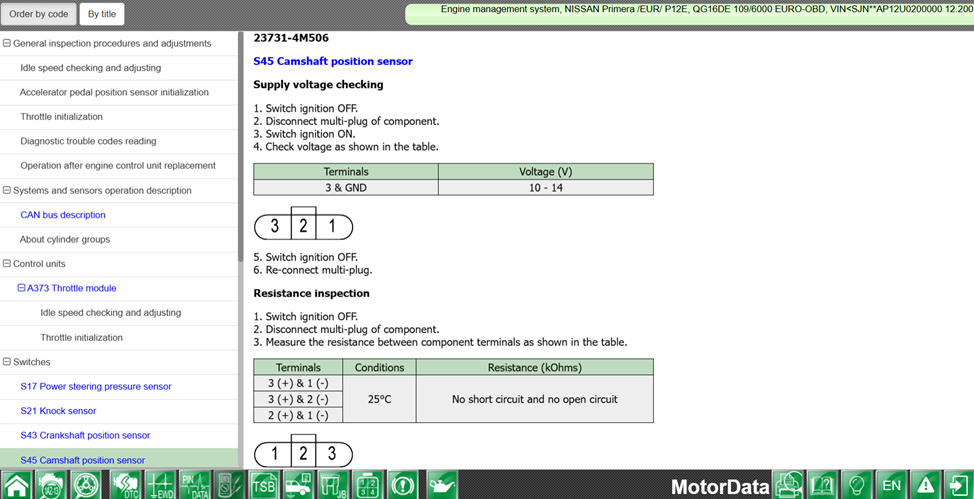
Another possible cause is damage to the crankshaft reluctor wheel. The sensor test procedure is described in Component Inspection and General Test Procedures.
A stretched timing chain or incorrect timing chain installation can also cause this code. In this case, the synchronization between the crankshaft position sensor and camshaft position sensor signals must be checked.
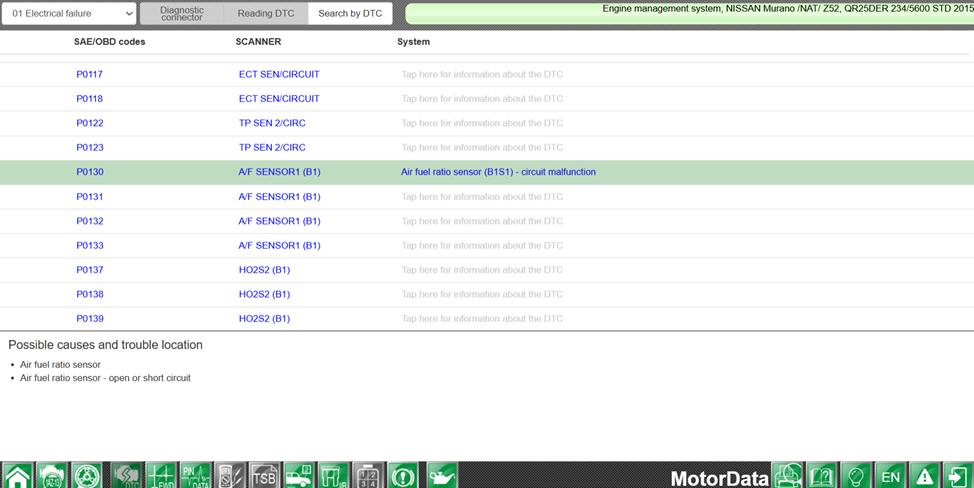
P0130 / P0131 / P0132 / P0133 — A/F Sensor Faults, Bank 1 Sensor 1
On VQ35DE engines used in Murano and Teana, a wideband A/F sensor — air/fuel ratio sensor — is installed upstream of the catalytic converter, not a conventional oxygen sensor. These parts must not be confused during replacement, and universal sensors should not be installed as substitutes.
Using non-genuine sensors on Nissan vehicles is strongly discouraged: the ECU may fail to recognize the signal from an aftermarket sensor and generate false trouble codes. Air/fuel ratio sensors usually have a service life of around 80,000–100,000 km, while oxygen sensors typically last 100,000–150,000 km.
P0130 indicates a general circuit fault in the front sensor. P0131 indicates low input, P0132 high input, and P0133 slow response, usually indicating sensor aging or degradation.
P0171 — System Too Lean, Bank 1
Code P0171 is one of the most common Nissan faults. It is found on Murano Z50/Z51 with the VQ35DE engine, X-Trail T30/T31 with QR25DE, Qashqai J10 with MR20DE, and Note and Tiida with HR16DE. The ECU detects that long-term fuel trims, LTFT, have exceeded the allowed threshold of approximately +10–12%, indicating a persistent lean mixture.
Code P0172, system too rich, is less common but just as important. It points to the opposite condition, where LTFT values move heavily into the negative range.
Typical causes of P0171 include unmetered air entering the intake tract after the MAF sensor — throttle body gasket, intake manifold gaskets, injector O-rings; a contaminated or failed MAF sensor; a faulty fuel pump or fuel pressure regulator; restricted injectors; and leaks in the PCV system. On Nissan Murano Z50, the intake manifold gaskets deserve special attention, as their deterioration is a known weak point of this platform.
P0201–P0204 — Injector Circuit Faults
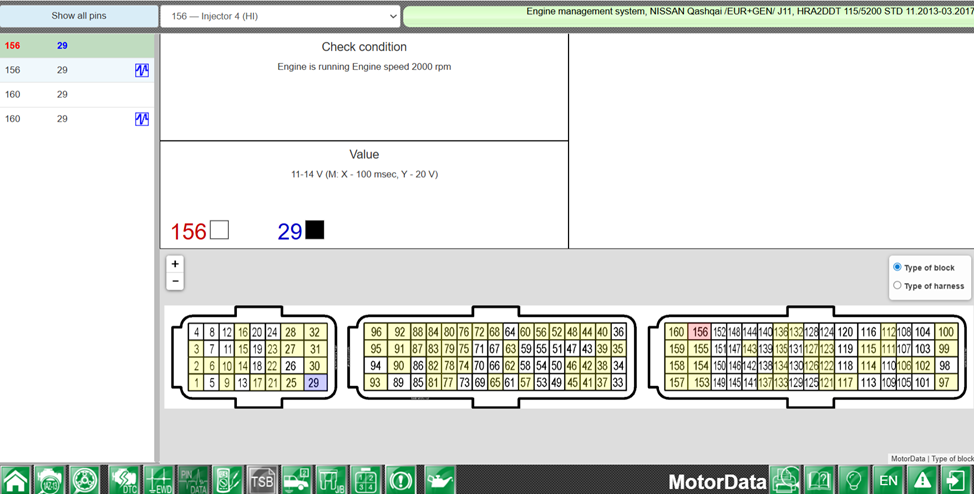
Codes P0201, P0202, P0203 and P0204 indicate an open circuit or fault in the injector control circuit for the corresponding cylinder. On Nissan vehicles, this usually means a broken injector wire, corrosion in the connector, or less commonly, failure of the injector itself.
These codes are almost always accompanied by a misfire code in the same cylinder, such as P0301–P0304, which helps narrow down the diagnostic path.
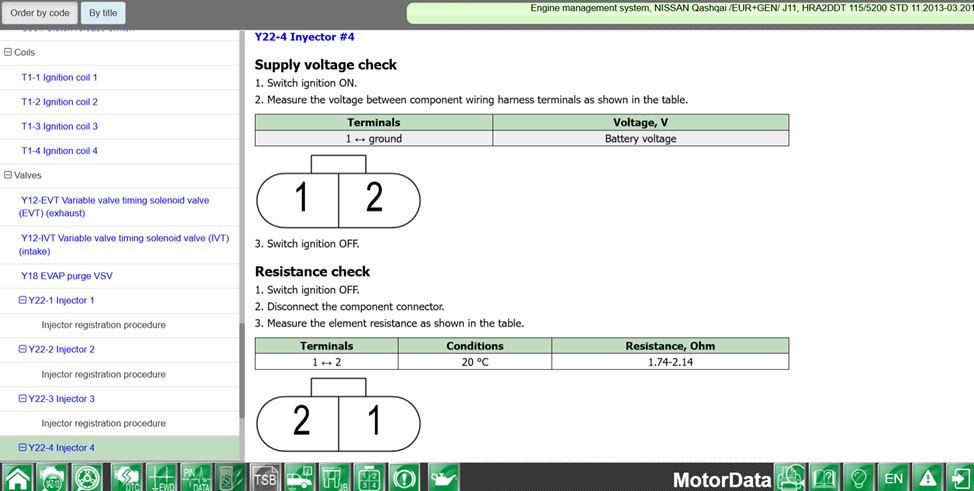
The injector test procedure is provided in Component Inspection and General Test Procedures.
P0300–P0304 — Misfire Codes
Misfires on Nissan engines such as VQ35DE, used in Murano, Teana and Maxima, and QR25DE, used in X-Trail T31/T32 and Teana L33, are most often caused by worn spark plugs or failed ignition coils.
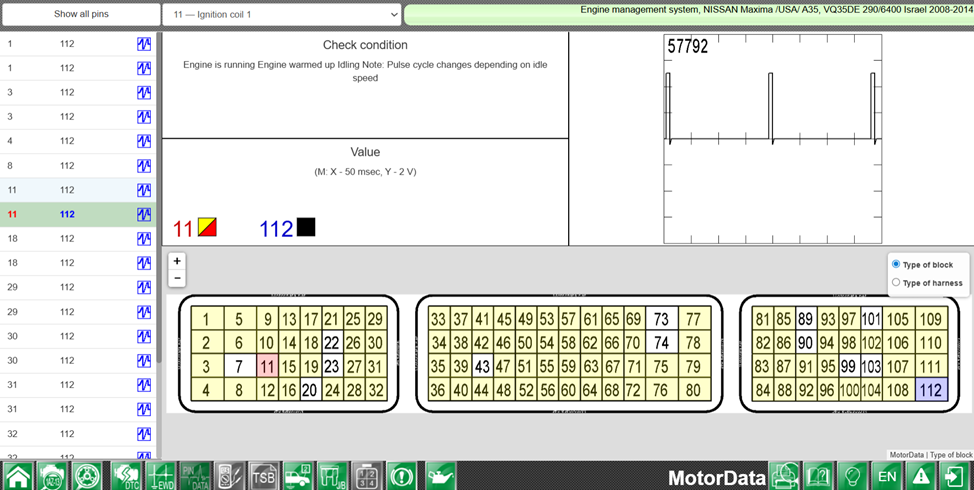
A common Nissan feature is that each spark plug has its own individual ignition coil — coil-on-plug, COP/DIS type. Identifying a faulty coil is straightforward: move the coil to another cylinder and check whether the misfire code follows it. If the code moves with the coil, the coil is faulty. If it stays on the same cylinder, the cause is more likely the injector, spark plug or a mechanical issue.
The PinData section includes the ignition coil control signal test.
P0325 / P0328 — Knock Sensor
On Nissan naturally aspirated VQ35DE and QR25DE engines, code P0325, knock sensor low input/circuit fault, often appears after 120,000–150,000 km. A faulty knock sensor prevents the ECU from properly optimizing ignition timing, which leads to reduced power and increased fuel consumption.
Diagnostics must include not only the sensor itself but also the condition of its shielded wiring.
P0011 / P0014 and CVTC Codes: A Typical Nissan QR25DE Issue
Codes P0011, intake valve timing control, Bank 1, and P0014, exhaust valve timing control, are highly typical for Nissan Teana L33 and X-Trail T32 with the QR25DE engine, as well as Qashqai J11 with MR20DD.
The CVTC system controls the camshafts through oil control solenoids installed in the front upper engine cover. If engine oil is not changed on time or oil of the wrong viscosity is used, the solenoids become contaminated, their flow capacity drops, and the cam phasers can no longer reach the commanded position.
Typical symptoms include loss of power, unstable idle, hesitation or jerking during acceleration, and hard starting. P0011 and P0014 are often stored together with P052B, Cold Start “B” Camshaft Position Timing Over-Retarded, Bank 1.
Replacing only one control solenoid usually does not provide a stable repair. It is recommended to replace all control solenoids together and also inspect and replace the solenoid O-rings if necessary. Damaged O-rings can completely cancel out the effect of replacing the solenoids themselves. Codes P0075 and P0078 belong to the same fault group and point directly to electrical faults in the CVTC control solenoid circuits.
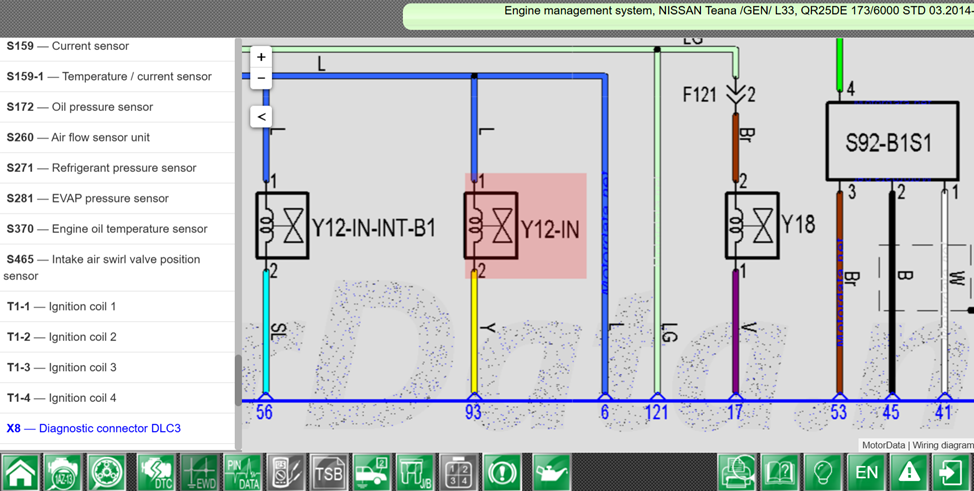
P0420 and P0444/P0445: Catalyst and EVAP System
Code P0420 on Nissan vehicles is stored when the ECU compares the signals from the upstream and downstream oxygen sensors and determines that the catalytic converter has lost efficiency. In most cases, this is actual catalyst wear after 100,000–150,000 km. Less commonly, the cause is a faulty rear oxygen sensor or the result of repeated misfires.
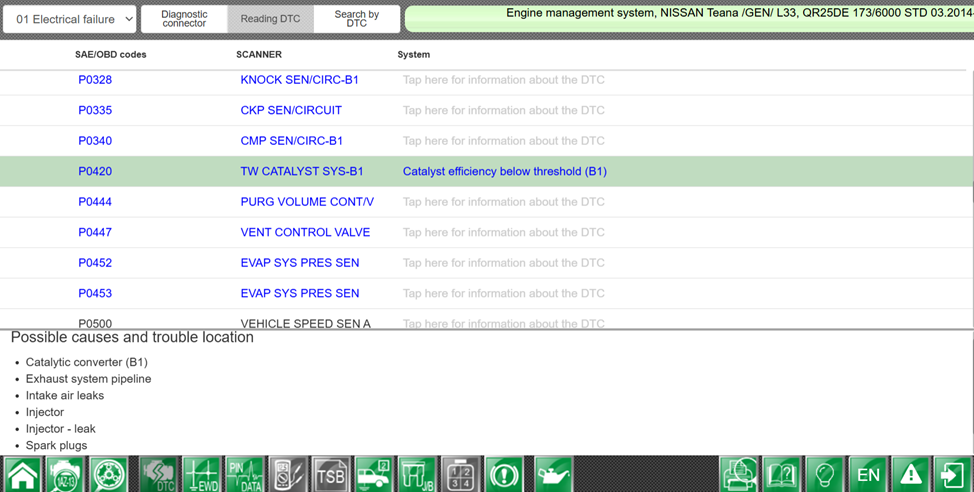
Diagnosing P0420 without live data is very difficult. The rear oxygen sensor signal after a properly working catalytic converter should be almost stable and should not switch in phase with the front sensor.
Codes P0444, EVAP purge valve open circuit, and P0445, EVAP purge valve short circuit, are related to the evaporative emission control system. These codes often appear without obvious drivability symptoms, except for the Check Engine light.
Common causes include a faulty purge valve, damaged EVAP vacuum hoses, or a leak in the charcoal canister.
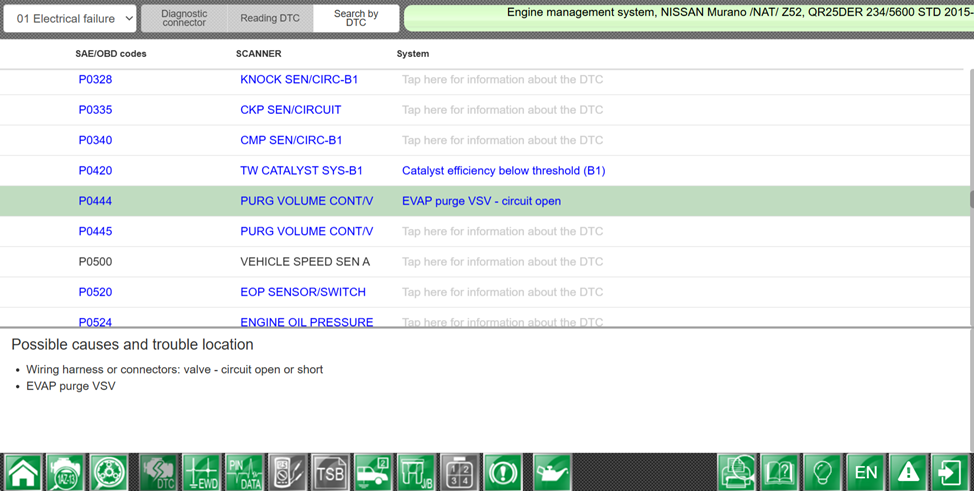
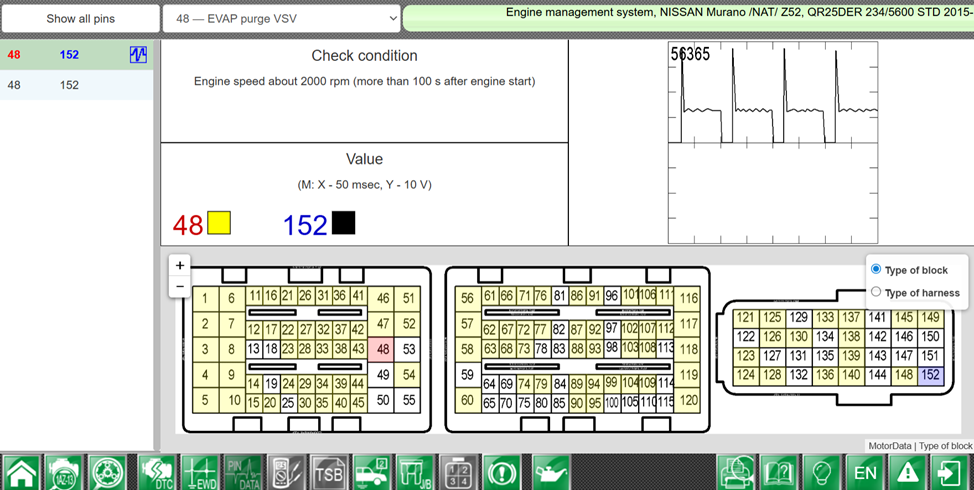
The PinData section describes how to test the valve electrical circuit. The oscilloscope waveform can also help identify a mechanical fault inside the valve.
Nissan Transmission Trouble Codes: CVT and Automatic Transmission
The transmission is one of the most vulnerable systems on modern Nissan vehicles, especially the Jatco CVT used on X-Trail T31/T32, Qashqai J10/J11, Murano Z51, Note and Micra. Codes in the P07xx and P17xx groups relate to the transmission.
Code U0101, Lost Communication with ATCU/TCM, means the engine ECU has lost communication with the transmission control module. This may be caused by an actual TCM failure, a CAN bus issue, or a power supply problem.
Codes P0740/P0745, related to CVT solenoids, often indicate contamination in the hydraulic system. The best preventive measure is replacing the CVT fluid every 40,000–60,000 km instead of relying on the manufacturer’s “filled for life” concept.
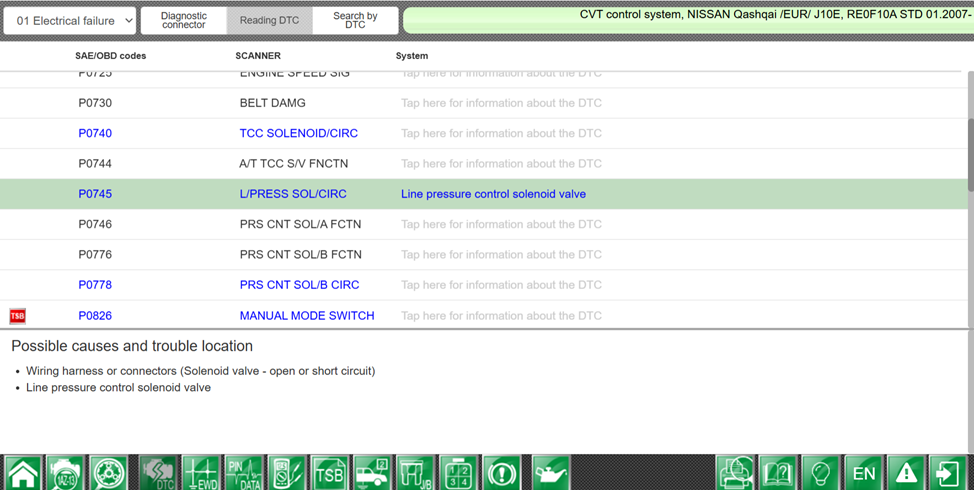
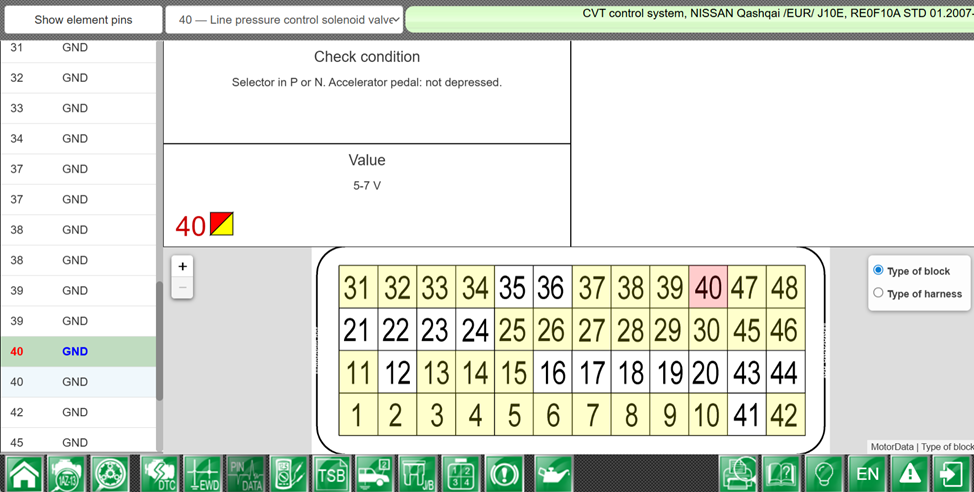
The PinData section shows the connection point at the control module, test results and test conditions for the line pressure control solenoid valve.
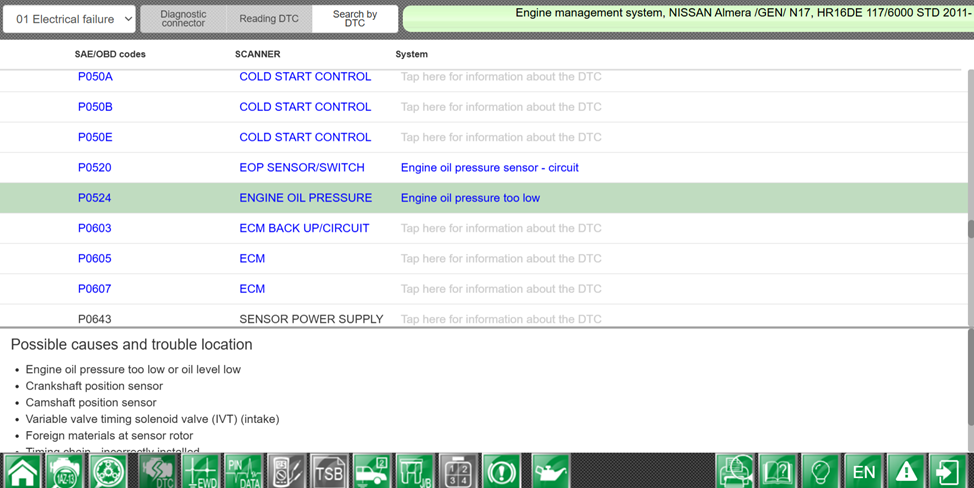
P0520 / P0524: Engine Oil Pressure
Code P0520 indicates a fault in the engine oil pressure sensor or switch circuit. Code P0524 indicates critically low engine oil pressure.
On Nissan Murano and Pathfinder with the VQ35DE engine, these codes require immediate attention. Low oil pressure while the engine is running means a real risk of scoring and damage to the main and connecting rod bearings. Continued operation with low oil pressure will lead to severe engine damage and eventual seizure.
Before replacing the oil pressure sensor, actual oil pressure must be verified with a mechanical pressure gauge.
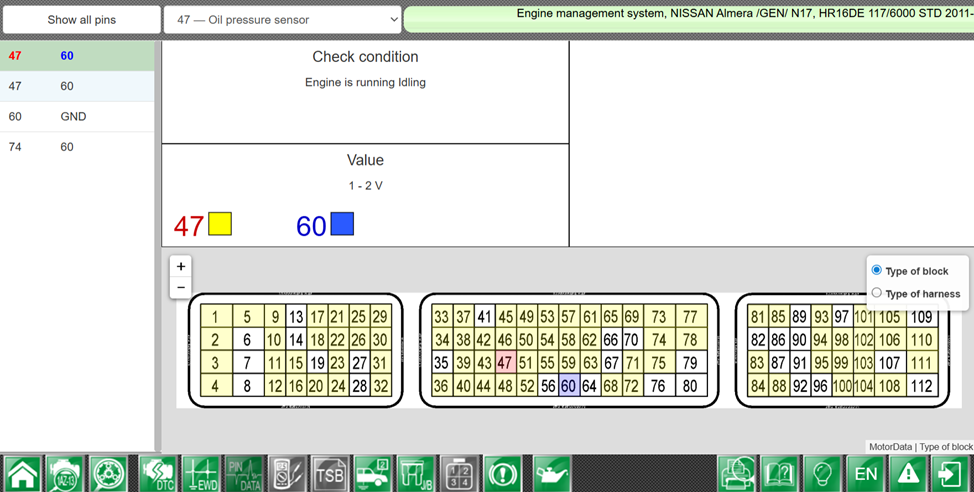
The oil pressure sensor test procedure is described in PinData.
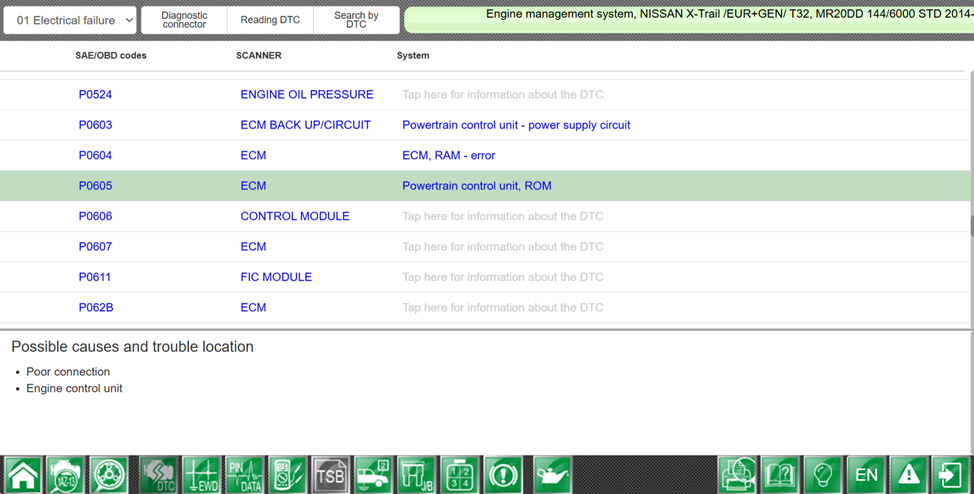
P0603 / P0604 / P0605 / P0606: ECU Faults
These codes indicate internal faults in the engine control module. P0603 is a backup power supply or Keep Alive Memory fault. P0604 is a RAM error. P0605 is a ROM fault. P0606 is a processor fault.
In practice, P0603 and P0604 may sometimes appear after a deeply discharged battery or unstable power supply and may disappear after the battery is fully charged. Codes P0606 and P0605 require mandatory specialist inspection and ECU testing on dedicated bench equipment.
P2100 / P2101 / P2135 — Electronic Throttle Control System
Codes in the P21xx group on Nissan Murano Z51, Teana L33 and X-Trail T32 are related to the electronic throttle control system.
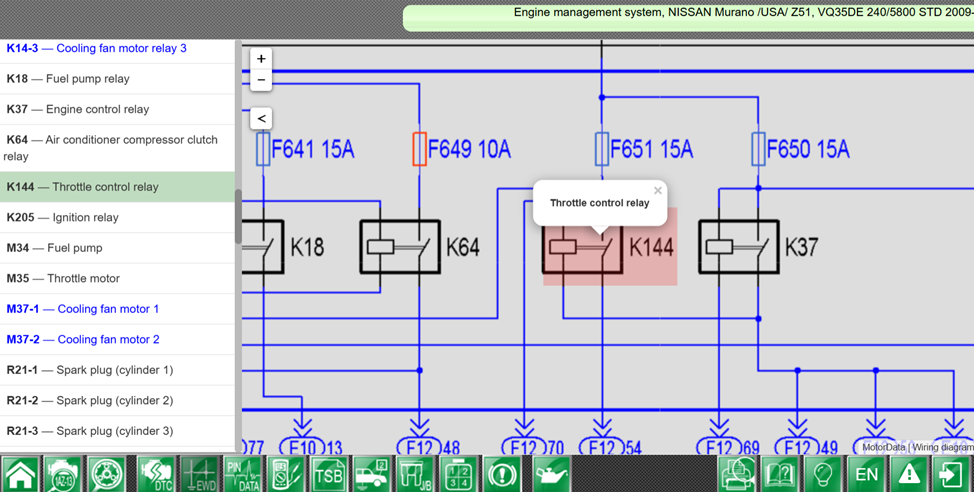
P2100 indicates an open circuit in the throttle control motor relay power supply. In the wiring diagram, the relay, control module and the terminal where voltage must appear when the relay is activated are shown.
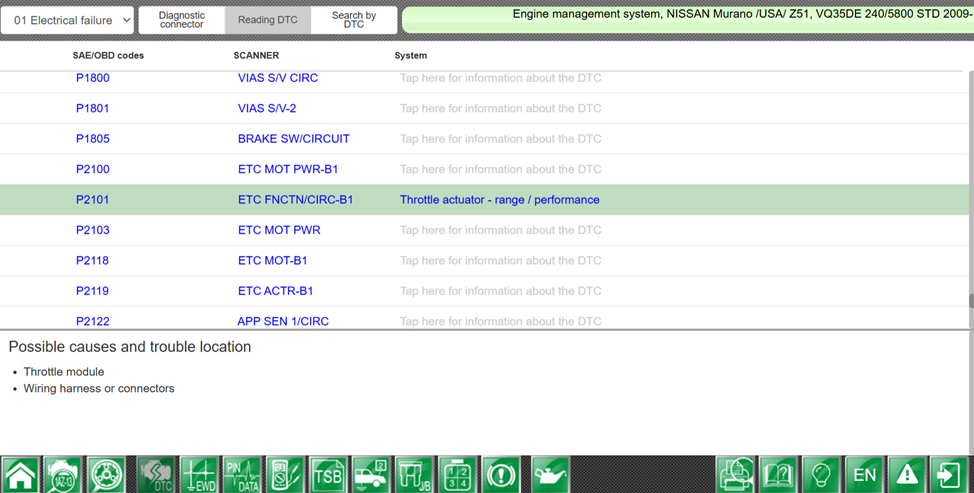
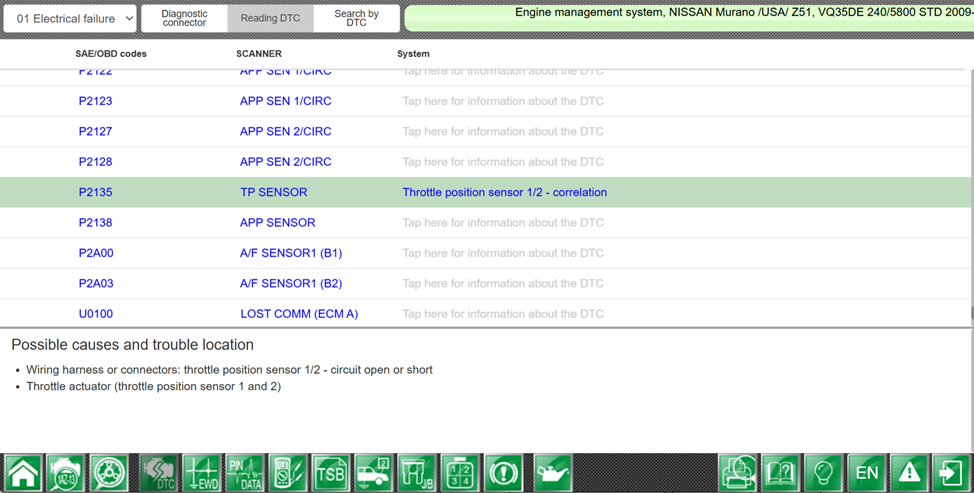
P2101 means the throttle actuator operation is outside the allowable range. P2135 indicates correlation mismatch between the two throttle position sensor signals, TPS1 and TPS2.
P2135 is especially tricky: it may be caused by throttle body contamination or by drift in the parameters of throttle position sensors 1 and 2. These sensor values can drift or change due to high temperature.
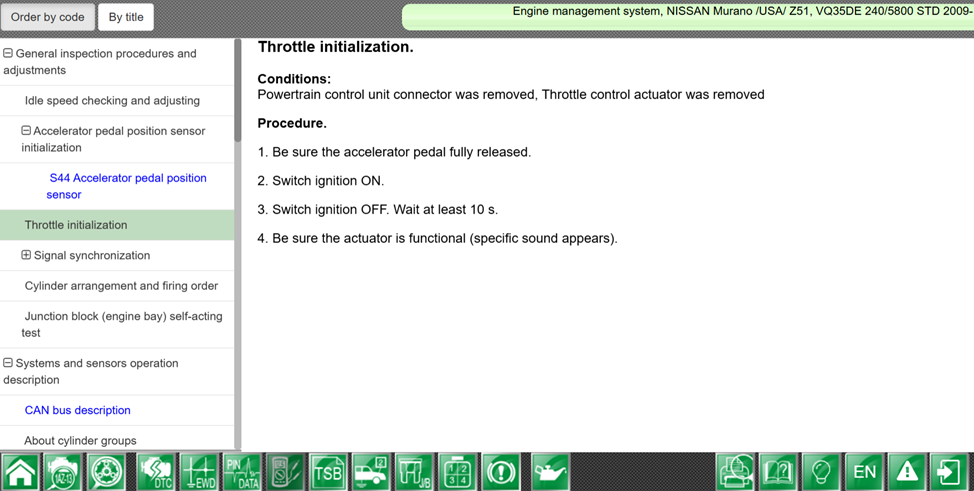
Before replacing the complete throttle body assembly, throttle initialization should be performed using diagnostic equipment. The throttle valve initialization procedure is described in the Component Inspection section.
CAN Bus Codes: U0101 and U1000/U1001
Code U0101, Loss of Communication with ATCU/TCM, means the engine ECU has lost communication with the transmission control module.
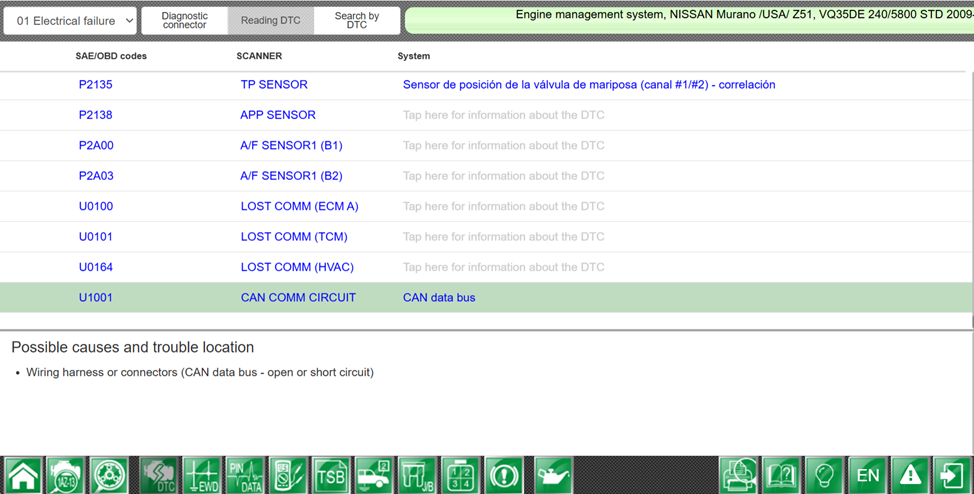
This may appear as the transmission being stuck in one gear, no gear shifting, or CVT/automatic transmission fail-safe mode. Codes U1000 and U1001 indicate a general CAN bus communication fault.
For all three codes, the first step is to check the battery condition and the quality of the battery terminal connections. Voltage dropping below 10.5 V during cranking is one of the most common “false” causes of CAN communication faults on Nissan vehicles.
Nissan Manufacturer-Specific P1xxx Codes: What a Standard Scanner May Miss
P1273 / P1283 — Air/Fuel Ratio Sensor Lean Shift Monitoring, Bank 1 / Bank 2
These codes are specific to VQ35DE engines used in Murano Z50/Z51, Teana J31/J32, Pathfinder R51 and Maxima A34. Unlike a conventional lambda sensor, Nissan uses a wideband A/F sensor, which is more sensitive to air/fuel mixture deviations.
P1273 refers to Bank 1, while P1283 refers to Bank 2.
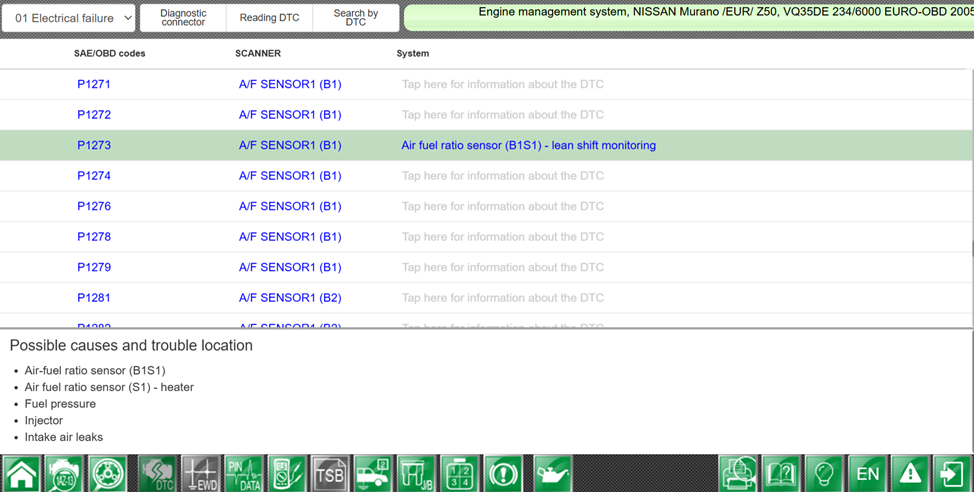
Possible causes include A/F sensor failure, unmetered intake air, a contaminated MAF sensor, or fuel delivery issues. Diagnosis without a specialized database is difficult because low-cost universal scan tools may not recognize or decode these codes correctly.
P1148 / P1168 — Closed-Loop Fuel Control Fault
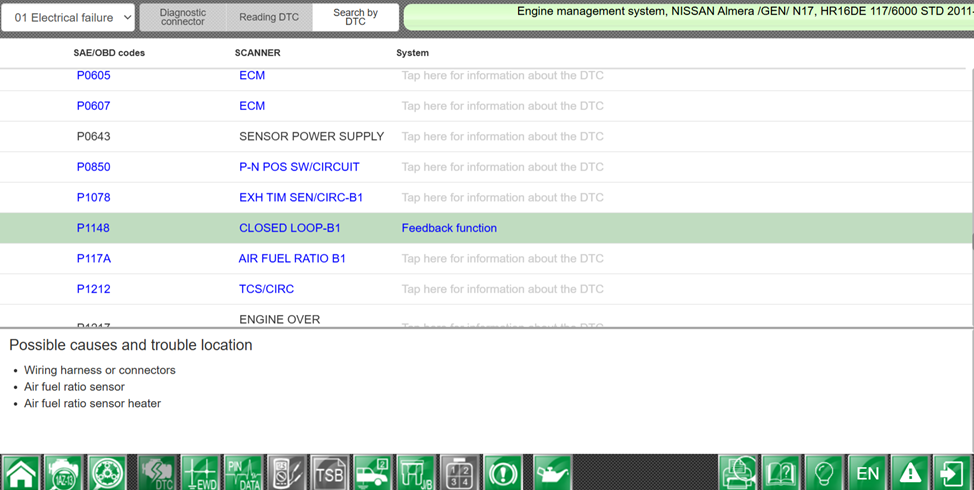
P1148 means the ECU cannot enter closed-loop operation on Bank 1 — fuel correction based on the air/fuel ratio sensor signal. This usually occurs when the front A/F sensor circuit has an open circuit or short circuit.
P1168 is the same condition for Bank 2, typically the right-hand bank of the VQ35DE engine. Both codes often appear together with P0171/P0174, lean mixture on both banks, indicating a system-level issue with the A/F sensors or their wiring.
P1217 — Engine Overtemperature
Code P1217 is stored by the ECU when coolant temperature reaches a critical level. It indicates overheating long before the condition may become obvious on the analog temperature gauge.
On Nissan Murano and Pathfinder with the VQ35DE engine, overheating is often caused by a clogged radiator, faulty thermostat, or loss of cooling system sealing.
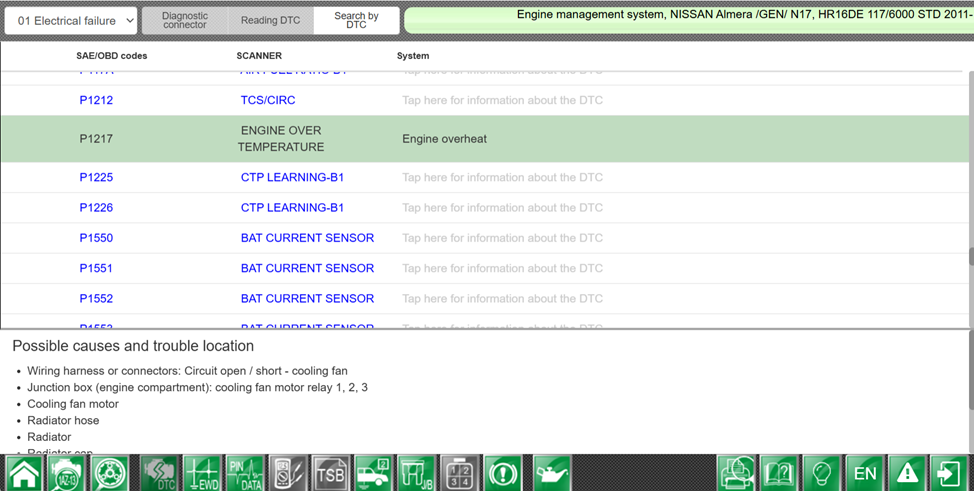
How to Work with Nissan Codes in MotorData
The MotorData Automotive Wiring database contains a complete list of DTCs for all popular Nissan models — from Almera Classic and Primera to Murano Z52 and Pathfinder R52. It includes manufacturer-specific P1xxx codes that are not available in standard OBD-II databases.
For each code, MotorData provides the code definition, possible causes, and applicability by engine and vehicle generation.
The correct workflow for any trouble code is as follows: read all fault codes — active, stored and pending; check freeze frame data — operating conditions at the moment the fault was recorded; review live data — current parameters; perform code-related diagnostics; repair the fault; clear the code; and perform a confirmation road test.
Clearing the code without repairing the root cause only turns off the Check Engine light temporarily. During the next diagnostic cycle, the ECU will detect the fault again and store the code once more.
FAQ: Nissan Trouble Codes
Question: Why is the Check Engine light on if the car drives normally?
Answer: Many Nissan trouble codes are stored when the ECU detects deviations that do not yet cause obvious drivability symptoms. Examples include P0420 for catalyst efficiency, P0455 for EVAP leaks, and oxygen sensor heater faults. These codes should not be ignored: they usually indicate the early stage of component degradation, which may lead to more serious problems over time.
Question: Can I clear a Nissan fault code myself by disconnecting the battery terminal?
Answer: Technically, yes, but it is not best practice. Disconnecting the battery will clear the codes, but it will also erase ECU adaptations such as fuel trims and idle learning. This may temporarily worsen engine operation. In addition, some Nissan codes require specific drive-cycle conditions to confirm that the fault has actually been repaired.
Question: What is the difference between P1273 and P0171 on Nissan?
Answer: P0171 is a generic SAE code indicating that the fuel system is operating lean, usually because LTFT values have moved into the positive range. P1273 is a Nissan manufacturer-specific code that more precisely indicates that the wideband A/F sensor on Bank 1 has detected a persistent lean shift. Both codes may appear at the same time and can point to the same root cause, but P1273 provides additional diagnostic detail.
Question: Are P0011 and P0014 urgent codes?
Answer: Yes. Incorrect CVTC cam phaser operation means the engine is not getting proper valve timing under any operating condition. Continued driving with these codes accelerates timing chain wear and may eventually lead to chain jump or chain failure.
